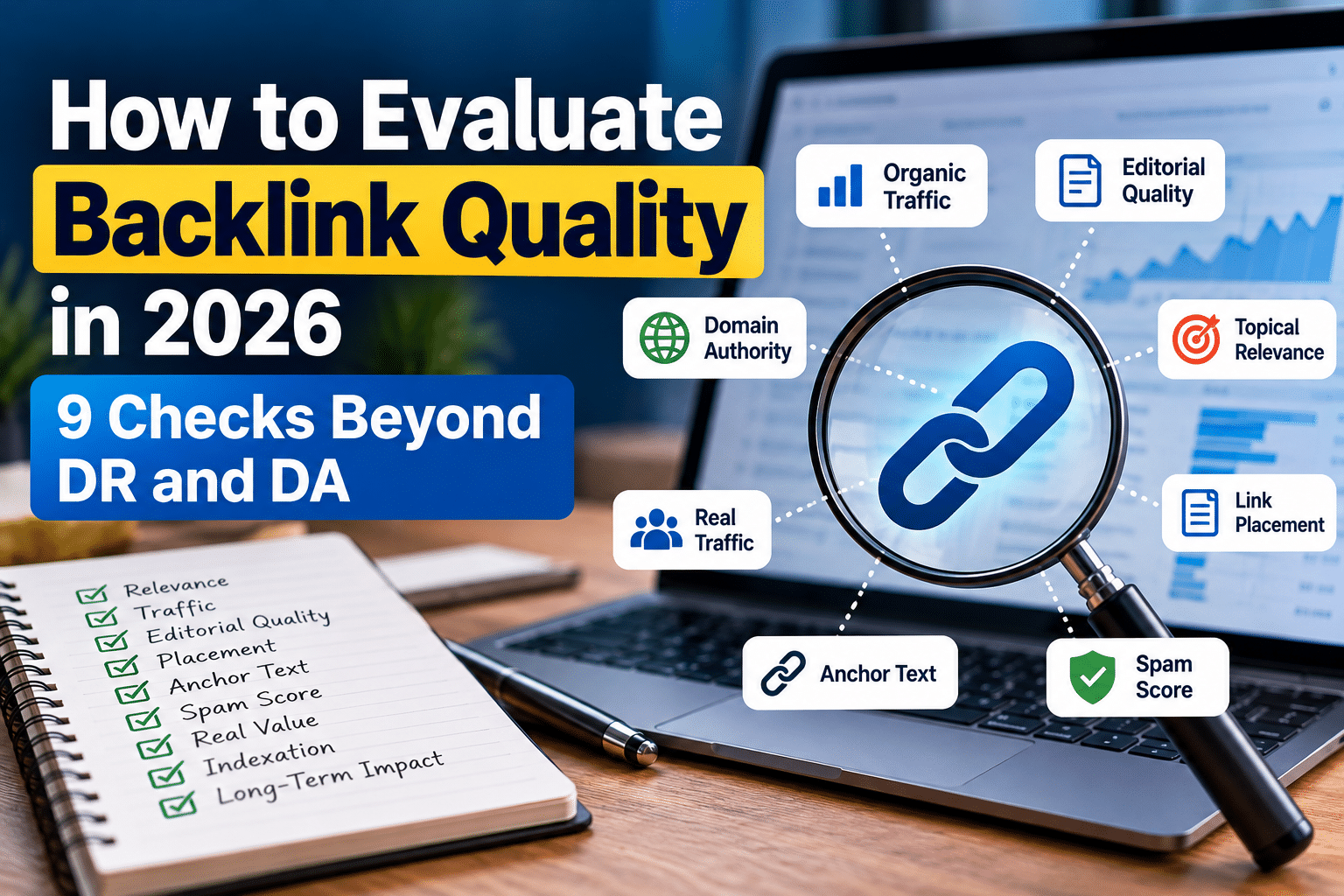

A backlink can come from a website with an impressive Domain Rating and still offer little value to your SEO campaign. The site may have an unrelated audience, declining organic visibility, thin content, or pages created mainly to sell links. A smaller specialist publication may be a stronger opportunity because its readers and subject matter closely match your business.
Evaluating backlink quality requires more than checking a single score. DR and DA are third-party metrics, not Google ranking scores. A useful assessment considers relevance, credibility, editorial context, traffic patterns, and whether the link genuinely helps readers.
Use these nine checks before investing time in outreach or paying for a placement.
1. Check Topical Relevance First
Ask whether the linking website and the specific page make sense for your subject. A backlink from a SaaS operations blog to a B2B software company may fit naturally. A link from an unrelated entertainment site may be harder to justify, even if its DR is much higher.
Review the site's main topics, recent articles, categories, and intended audience. Then inspect the exact page where your link would appear. The surrounding paragraph should make the reference useful and understandable.
A practical test: if the link were removed, would the paragraph still make sense—and would the reference help a reader learn more? If the link feels inserted only for SEO, reconsider the opportunity.
2. Investigate Organic Traffic and Its Trend
Estimated organic traffic can help show whether a website attracts search visitors, but third-party estimates are directional rather than exact. Look at the trend over several months instead of judging a site from one snapshot.
See Semrush's link building guide for additional background on prospecting and assessing link opportunities.
A sharp, unexplained drop may reflect lost rankings, a migration problem, or a change in content quality. A sudden spike also deserves a closer look if it seems unrelated to the site's normal topics. Where possible, check which pages and countries contribute to traffic.
Do not reject every low-traffic site automatically. A niche resource may reach exactly the right audience. Use traffic as one factor, not a universal pass/fail threshold.
3. Review Editorial Standards
Look for useful, original articles with clear authorship and a coherent subject focus. Be cautious when a website publishes unrelated topics in rapid succession, accepts nearly any contributed article, or fills pages with generic copy and commercial links.
Review several recent posts, not just the homepage. Check whether claims are supported, examples are useful, and the site offers value beyond a place for marketers to insert links.
4. Inspect the Exact Page and Link Placement
A domain-level score cannot tell you whether a specific placement is useful. Open the target page and evaluate its content, visibility, and context. A relevant in-content citation can be more useful to readers than a link buried in a generic author bio, footer, or unrelated list.
Check that the page is accessible, the link fits naturally into its surrounding paragraph, and the destination supports the claim or offers the additional detail promised by the anchor text.
5. Look at Outbound-Link Patterns
Review other links on the site and similar pages. Relevant links to useful tools and credible references can be a positive sign. Excessive commercial anchors, unrelated destinations, or multiple outbound links packed into thin articles deserve scrutiny.
Look for patterns rather than treating one outbound link as proof of a problem. The key question is whether links serve readers and fit the site's editorial standards.
6. Evaluate Anchor Text Naturally
Anchor text should describe the destination clearly and fit the sentence. Branded anchors, URLs, descriptive phrases, and occasional keyword-related wording can all appear naturally in a backlink profile.
For more guidance on writing descriptive anchors and creating crawlable links, consult Google's link best practices.
Repeatedly demanding the same exact-match commercial keyword across many placements can create an unnatural pattern. Choose wording for readers, not solely for a target keyword. For example, 'SaaS SEO strategy guide' may be a natural anchor in a relevant software marketing article but forced in an unrelated topic.
7. Confirm the Link Attribute and Disclosure
Check whether a link is marked follow, nofollow, or sponsored. These attributes communicate information about the relationship between the linking page and destination. A properly disclosed mention can still bring referral visits, visibility, and brand recognition.
Google's spam policies identify paid links that pass ranking credit, excessive link exchanges, automated link creation, and other manipulative practices as link spam. If money or another benefit is exchanged for a placement, the publisher should appropriately qualify the link, such as with rel='sponsored' or rel='nofollow'.
Before approving a paid placement, review Google's spam policies and make sure the approach does not rely on links intended to manipulate rankings.
Treat promises of guaranteed ranking improvements from a dofollow link with skepticism. No single placement guarantees a ranking outcome.
8. Assess Trust and Maintenance
Check whether the site looks like a real, maintained publication or business resource. Review its About and Contact pages, author information, publishing history, navigation, and consistency of branding. Look for a clear audience and a reason for the site to exist beyond selling placements.
No single detail proves trustworthiness. Combine multiple observations and use professional judgment.
9. Match the Opportunity to Your Campaign Goals
The best backlink depends on the campaign's goal. For referral traffic, audience fit and placement visibility may matter most. For topical authority, relevance and editorial context deserve close attention. For brand awareness, a credible mention in a publication your buyers read can be valuable even when direct traffic is modest.
Define the purpose before approving a placement and record why it qualifies. This makes decisions more consistent and helps explain the value to clients or stakeholders.
A Practical Backlink Quality Checklist
- The website and page are relevant to the target business or topic.
- Organic traffic estimates and trends have been reviewed where available.
- Recent content is useful, original, and editorially maintained.
- The target page is accessible and the link fits its context.
- Outbound-link patterns do not show obvious signs of mass placement selling.
- Anchor text reads naturally and describes the destination.
- Paid or sponsored relationships are qualified appropriately.
- The publisher has credible ownership, authorship, and contact information where expected.
- The opportunity supports a defined campaign goal beyond improving a metric.
Example: Two Backlink Opportunities Compared
| Factor | Site A | Site B |
| DR | DR 75 | DR 38 |
| Topic fit | Weak; unrelated topics | Strong; B2B software focus |
| Traffic pattern | Recent unexplained decline | Modest but stable relevant traffic |
| Editorial quality | Thin articles, many commercial links | Useful articles with clear context |
| Placement | Unrelated paragraph | Supports the discussion |
| Initial decision | Investigate carefully or decline | Potentially worth pursuing after checks |
Site A has the higher DR, but its other signals raise concerns. Site B has a lower score, yet appears more relevant and editorially credible. This does not guarantee that Site B will improve rankings; it shows why metrics should be evaluated together.
Common Mistakes When Evaluating Backlinks
- Choosing prospects by DR or DA alone.
- Treating estimated traffic as an exact measurement.
- Ignoring the specific page where the link will appear.
- Assuming every nofollow or sponsored link has no business value.
- Accepting irrelevant sites because they offer cheap placements.
- Using the same exact-match anchor repeatedly.
- Confusing a large backlink count with a useful backlink profile.
- Expecting one link to guarantee rankings or traffic.
Frequently Asked Questions
Is DR or DA more important than backlink relevance?
No. DR and DA are third-party metrics, not Google ranking scores. Relevance, page context, editorial credibility, and the purpose of the link should also influence your decision.
How much organic traffic should a linking website have?
There is no universal minimum. The right threshold depends on your niche, audience, and campaign goals. Review traffic trends and relevance rather than rejecting every low-traffic specialist site.
Are nofollow backlinks worth getting?
They can be. A nofollow link may send qualified visitors, increase brand exposure, or help people discover useful content. Evaluate its audience and context rather than judging it only by ranking credit.
Should I pay for a dofollow backlink?
Buying or selling links for ranking purposes can violate Google's link spam policies. Advertising and sponsorships should be disclosed and links appropriately qualified. Avoid ranking guarantees.
How often should I audit backlink quality?
Review new links as part of ongoing SEO reporting and conduct broader reviews periodically, especially after unusual changes in link acquisition or organic performance.
Conclusion
Evaluating backlink quality in 2026 means looking beyond a single authority score. Check topical fit, traffic trends, editorial standards, link placement, anchor text, link attributes, and publisher credibility. Then judge the opportunity against your campaign's goals.
A disciplined review will not predict the exact effect of every backlink, but it can help you avoid weak opportunities and prioritize links that make sense for people as well as your SEO strategy.
For a sustainable approach, follow white hat link building principles and focus on editorial relevance rather than shortcuts. A broader understanding of SEO and quality link building can also help connect backlink evaluation with the rest of your SEO strategy. If you need support putting these practices into action, review professional SEO and link building services. The newer discussion of digital PR and editorial link building also explains how relevant coverage can support a quality-focused approach.